Knowledge does not become trustworthy because AI found it.
Cerebral Share is designed around an evidence-first, human-authority lifecycle that helps organizations move from everyday evidence to trusted institutional knowledge without pretending uncertainty does not exist.
Observe
Cerebral Share works with authorized organizational evidence from approved systems and content sources. Connector availability is qualified by deployment and pilot scope.
- Approved email / collaboration
- Calendars and meeting context
- Business documents
- Project records
- Customer / service records
- Operational information
- Training / knowledge systems
- Approved file repositories
Understand
Cerebral Share identifies potential knowledge, people and entities, relationships, decisions, plans, events, contradictions, process variation, unresolved questions, and organizational dependencies. It can connect related context that originated in different approved systems.
Clarify
When the evidence tells an incomplete story, Cerebral Share can surface the missing question instead of pretending it already knows the answer.
Validate
Responsible people review evidence and determine what becomes trusted or authoritative.
Use
Trusted intelligence may support operations, continuity, customer context, process improvement, search, training, decisions, and approved downstream systems.
Reassess
New evidence may show a plan changed, a decision was revised, documentation became stale, an unresolved question was answered, or a previously trusted interpretation needs review.
Machine 41 / Valve 17
A product scenario illustrating how Cerebral Share works in practice. Not a customer case study.
Everyday Work
A maintenance technician mentions in a team channel that "Machine 41 always throws the same error after a long weekend shutdown. We just reset Valve 17 and it clears." This is the kind of operational knowledge that rarely makes it into documentation.
Knowledge Signal
Cerebral Share identifies this exchange as potentially valuable operational knowledge. It finds supporting evidence: similar mentions in work orders, a note in a shift log, and a parts request history that correlates with the pattern.
Evidence
The system surfaces that the current documented troubleshooting guide does not mention Valve 17 in this context. The procedure says to check the pressure sensor first, which technicians have learned is not the actual fix.
Human Review
The maintenance supervisor receives a focused clarification request: "Your team appears to have a validated workaround not reflected in the current procedure. Can you review?" The supervisor confirms, adds safety context, and elevates the knowledge.
Trusted Knowledge
After review, the troubleshooting knowledge is validated with its evidence trail, safety notes, and the supervisor's authority. It is now trusted organizational knowledge, not just a hallway conversation.
Organizational Use
New technicians can now find this knowledge when they search. Training materials can reference it. If future evidence suggests a better fix, the knowledge can be reassessed rather than silently outdated.
A project can look finished in one system and unfinished everywhere else.
Evidence found → context connected → question surfaced → human clarification → trusted knowledge. Cerebral Share does not automatically determine the answer.
Planned
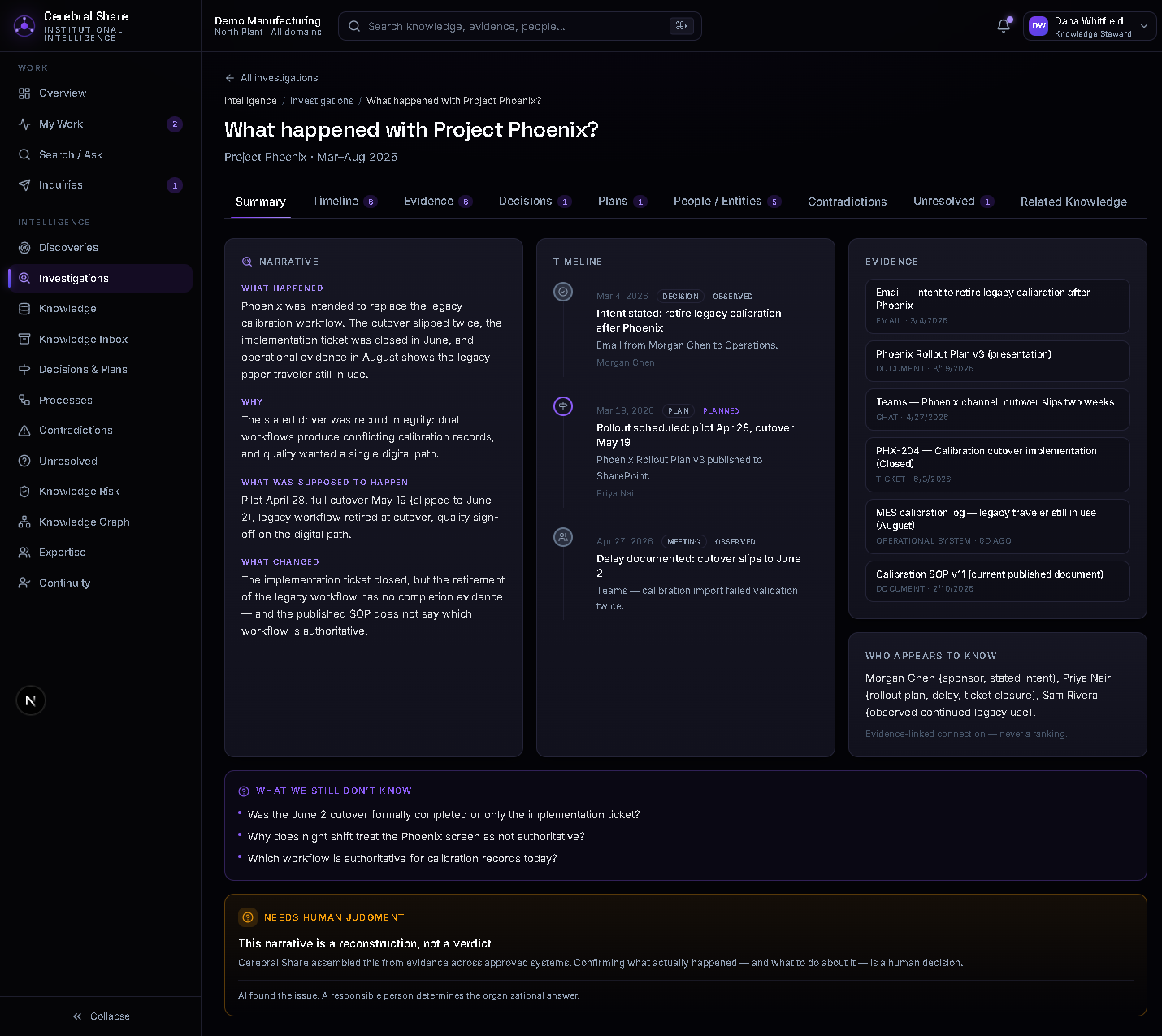
A company planned to replace a legacy calibration workflow with Project Phoenix. An email described the intended change.
Scheduled
A presentation scheduled the rollout across teams.
Delayed
A Teams discussion later documented a delay that never reached the plan of record.
Project Closed
The project system eventually showed implementation work as closed.
Legacy Practice Still Observed
Months later, operational evidence still showed employees using the legacy process, and the current procedure did not clearly explain what had actually become the standard.
Needs Clarification
Cerebral Share connects the evidence and surfaces the question for human review: was Project Phoenix fully implemented, partially implemented, or abandoned, and what process should the organization trust today?
Customer Account Continuity
Another product scenario showing knowledge preservation in a customer context.
A senior account employee changes roles after years of building important customer-specific knowledge. Approved CRM records, communications, and business context reveal preferences, historical decisions, escalation nuances, and exceptions that deserve organizational review before the transition is complete.
Cerebral Share helps identify what knowledge deserves preservation, surfaces the evidence behind it, and routes it for validation, so the customer relationship does not depend on one person's memory.