
The biggest knowledge risk is often invisible until the business needs the answer.
It appears when one retirement slows a process, one departure takes customer history with it, one location uses a different standard, or the only person who can diagnose a failure is unavailable.
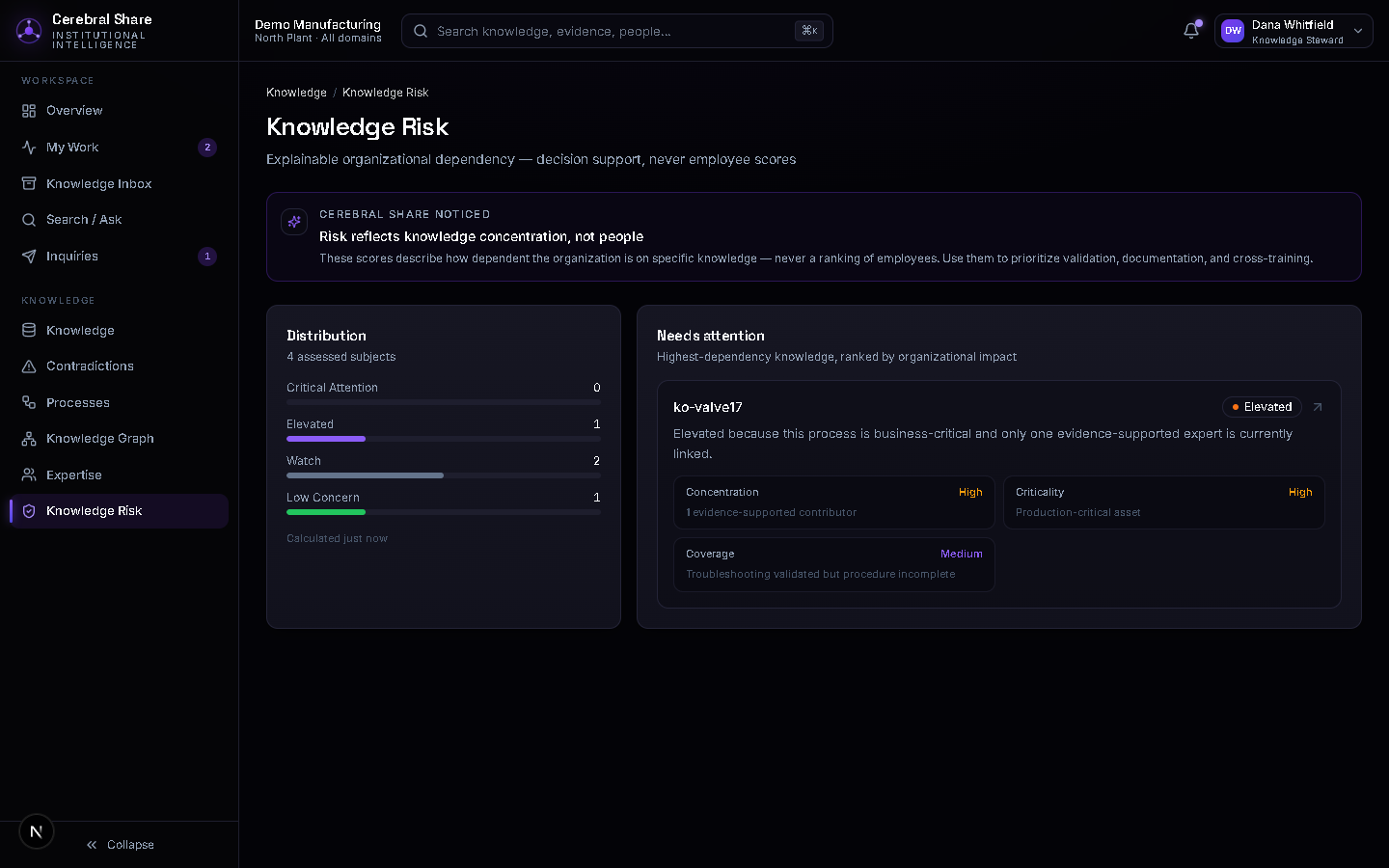
Cerebral Share evaluates organizational dependency on knowledge. It does not evaluate employee worth or productivity.
Eight dimensions of knowledge risk.
Concentration
How dependent is the organization on a small number of people or sources for important knowledge?
Criticality
How important is the process, customer, asset, system, or operation connected to that knowledge?
Coverage
Has the organization captured and validated enough of what it needs to operate reliably?
Redundancy
Is there validated backup expertise, or does the answer effectively live with one person?
Freshness
Is the knowledge still current, or has the business moved on while the documentation stayed behind?
Confidence
How strong and consistent is the evidence supporting what the organization believes?
Variation
Do teams, people, or locations describe the same work differently?
Dependency
What other work is affected if this knowledge is missing or wrong?
When knowledge risk becomes impossible to ignore.
“We have three key people approaching retirement.”
“Every location does this differently.”
“Only two people know how to diagnose this.”
“We keep retraining the same role from scratch.”
“The procedure says one thing, but the experienced team does another.”
“The acquired company has critical processes nobody fully documented.”
Critical context can be concentrated even when documents exist.
One person remembers why a decision was made.
One account owner knows the history behind a customer exception.
A project appears complete, but only the former lead knows what was actually implemented.
One technician understands why the documented troubleshooting path is misleading.
Cerebral Share evaluates the organization's dependency on knowledge and context, not the worth or productivity of individual employees.
Which important decisions would be difficult to explain if the people involved left?
Which projects have a status but no clear narrative of what actually happened?
Which customer commitments exist mainly in communication history?
Which procedures have a history nobody can easily reconstruct?
Which unresolved plans are carried mostly in people's memory?